Investigating the presence of yeast in ensiled Multispecies and Perennial Ryegrass – White Clover Grasses using PCR
Martínez, Andrea
Dundalk Institute of Technology
Dundalk, Irlanda
https://doi.org/10.33412/apanac.2025.75
Abstract
Preserving forages is a practice implemented to feed livestock during winter periods. This is a common practice in countries like Ireland that rely on the ensiling of forage by fermentation with lactic acid-bacteria (LAB). This is a process vulnerable to contamination by undesirable microorganisms, which may be introduced through treatment with fertiliser, in the form of either slurry or inorganic fertiliser, or both. The aim of this research project was to determine if there is presence of yeast in Multispecies (MS) and perennial ryegrass – white clover (PRG-WC) silage which has been stored under anaerobic conditions over time and showed heating. DNA was extracted and quantified for yield and purity. Yeast specific primers ITS1-F/NLB3 and ITS1/ITS2 were used to detect if yeast was present using the polymerase chain reaction (PCR) method. DNA yield (ng/μL) resulted to be higher in MS samples compared to PRG-WC. Also, the treatments containing slurry have a positive influence in the DNA yield of MS samples, more when it includes inorganic fertiliser, while in PRG-WC there is no significant effect. DNA purity has a positive influence on MS samples compared with PRG-WC, still, in both cases the results are below the recommended ratio for 260/280 and 260/230 nm absorbance, meaning the possible presence of contaminants.
Keywords: yeast, Multispecies (MS) silage, perennial ryegrass – white clover (PRG-WC) silage, slurry, polymerase chain reaction (PCR).
Resumen
La conservación de forrajes es una práctica que se lleva a cabo para alimentar al ganado durante los períodos de invierno. Se trata de una práctica habitual en países como Irlanda, que dependen del ensilado de forrajes mediante fermentación con bacterias ácido-lácticas (BAL). Este proceso es vulnerable a la contaminación por microorganismos indeseables, que pueden introducirse a través del tratamiento con fertilizantes, ya sea en forma de purines, fertilizantes inorgánicos o ambos. El objetivo de este proyecto de investigación era determinar si hay presencia de levadura en el ensilado multiespecie (MS) y de raigrás perenne y trébol blanco (PRG-WC) que se ha almacenado en condiciones anaeróbicas durante un tiempo y ha mostrado calentamiento. Se extrajo y cuantificó el ADN para determinar su rendimiento y pureza. Se utilizaron cebadores específicos para levaduras ITS1-F/NLB3 e ITS1/ITS2 para detectar la presencia de levaduras mediante el método de la reacción en cadena de la polimerasa (PCR). El rendimiento de ADN (ng/μL) resultó ser mayor en las muestras de MS en comparación con las de PRG-WC. Además, los tratamientos que contienen purín tienen una influencia positiva en el rendimiento del ADN de las muestras MS, más aún cuando incluyen fertilizantes inorgánicos, mientras que en PRG-WC no se observa ningún efecto significativo. La pureza del ADN tiene una influencia positiva en las muestras MS en comparación con PRG-WC, aunque en ambos casos los resultados están por debajo de la relación recomendada para la absorbancia de 260/280 y 260/230 nm, lo que significa la posible presencia de contaminantes.
Palabras claves: levadura, ensilado multiespecie (MS), ensilado de raigrás perenne y trébol blanco (PRG-WC), purín, reacción en cadena de la polimerasa (PCR).
1. Introduction
Agriculture is a key sector in Ireland, occupying about 67.7% of the land primarily for livestock farming, contributing 4% to exports through animal feed [1]. The sector is sensitive to climate and soil conditions, with 2023 experiencing reduced rainfall negatively impacting grass and cereal crop growth [2]. Ireland’s livestock system relies mainly on a grass-based feeding regime, which struggles in winter, leading to the adoption of forage preservation through silage, crucial for year-round feed availability [1][3]. Grass silage, conserved via anaerobic fermentation by lactic acid bacteria (LAB), accounted for 80.6% of farmed land in 2019 [4][5]. LAB produces lactic acid, which promotes the formation of beneficial volatile fatty acids in the rumen [6].
Enhancing silage involves fertilization, either inorganic or organic. Inorganic fertilizers comprising nitrogen, phosphorus, calcium, magnesium, and potassium boost yield and crude protein content but can increase greenhouse gas emissions through nitrogen losses [7][8][9]. Organic slurry, a semi-liquid manure, supplies nutrients but risks forage contamination and emissions that may reduce feed acceptance [1][10].
Silage types include grass, herbs, cereals, and legumes, with perennial ryegrass (PRG) dominant in Ireland due to its cold climate adaptability, though requiring significant inorganic fertilizer inputs [11]. Multispecies (MS) silage mixes including legumes like white clover can improve animal health, enhance biodiversity, and reduce fertilizer use due to nitrogen fixation [12][13].
Microbial dynamics in silage critically affect fermentation quality. Undesirable microbes like yeasts cause spoilage by metabolizing lactic acid and increasing pH, leading to nutrient loss and health risks [5][14]. While traditional culture methods are limited, molecular tools such as PCR and metagenomics enable detailed and efficient microbial community analysis, useful for managing silage quality [5][6][15].
2. Methods
A. Subsample collection
PRG-WC and MS silage samples were collected and produced by Ryan Callan, a PhD candidate under the supervision of Dr. Joseph Lynch, DkIT. From there, samples that showed heating during ensiling were selected for further analysis and then stored at -80°C until further use.
B. DNA extraction
DNA extraction from silage samples was done taking 20 g of sample as outlined by [14] and with a change in the time of incubation of the DNA for lysis from 16 h to 1 h. The pellet was resuspended in the TE buffer for storage at −20°C. This procedure ensures effective cell lysis, removal of contaminants, and preservation of high-quality DNA suitable for further molecular analysis and quantification at 260/280 and 260/230.
C. Polymerase chain reaction (PCR)
The PCR was carried out using the Applied Biosystems Veriti machine following these cycling parameters: first denaturalisation at 95°C for 5 minutes, a cycle of 35 repetitions (denaturalisation at 95°C for 30 seconds, annealing at 60°C for 30 seconds and extension at 72°C for 60 seconds) and a final extension at 72°C for 5 minutes. MyTaq HS master mix (Bioline) and reagents were prepared in a total volume of 50 μL using: 25 μL of MyTaq HS Mix, 1 μL of each primer (forward and reverse), 200 ng/L of the template DNA (Volume adjusted based on initial concentration of DNA) and H2O (Volume adjusted based on initial concentration of DNA).
The products were visualized on a 1% agarose gel for 90 minutes at 81 V and visualized in a transilluminator.
D. Statistical analysis
The statistical analysis of DNA yield and purity from Nanodrop measurements was conducted using unpaired t-tests and one-way analysis of variance (ANOVA) via MS Excel.
3. Results
A. The grass type has an influence on the DNA yield
A mean of 36.08 ± 4.16 (ng/μL) was obtained for PRG-WC samples and for the MS samples a mean of 100.59 ± 25.37 (ng/μL) as it is shown on Figure 1. An unpaired t-test was developed, and a p-value of 0.02 was obtained, which means there is evidence to say there is a statistically important difference between the total DNA yield (ng/μL) of the PRG-WC and the MS silage.
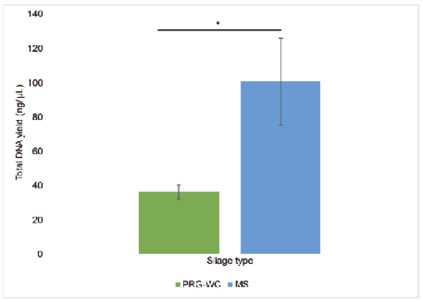
Figure 1. Total DNA yield (ng/μL) of PRG-WC vs. MS. The mean of the yield (ng/μL) for PRG-WC and MS was compared using an unpaired t-test. * p-value > 0.02. Error bars show the standard error of the mean (SEM).
B. Yeast identification through PCR
The ITS1 and ITS2 region of the yeast genome was amplified through PCR using the pair of primers ITS1-F, NLB3, ITS1 and ITS2. The amplicons were prepared to be seen on 1% agarose gels and analysed using a transilluminator as presented on Figure 2 and Figure 3. This resulted in the absence of yeast in the silage samples as it is confirmed by the amplification of the positive control with the pair of primers ITS1-F and NLB3, where the expected size is between 800 and 1000 bp [16]. While for the pair of primers ITS1 and ITS2, an expected size of 300 bp [17].
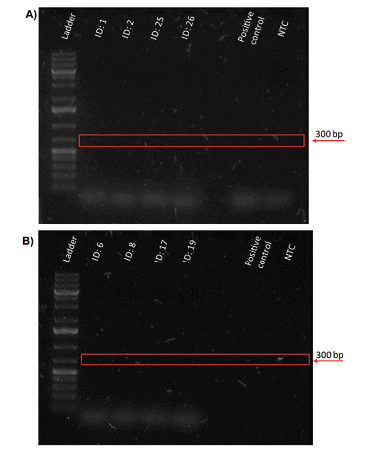
Figure 2. ITS1 and ITS2 amplicons. Electrophoresis separation was performed on 1% agarose gel, stained with SYBR safe. A) Lane 1: Ladder (20 kb), Lane 2: PRG-WC/100 Slurry/No inorganic [ID: 1], Lane 3: MS/100 Slurry/No inorganic [ID: 2], Lane 4: PRG-WC/100 Slurry/No inorganic [ID: 25], Lane 5: MS/100 Slurry/No inorganic [ID: 26], Lane 6: Positive control (Yeast DNA) and Lane 7: No template control (NTC). B) Lane 1: Ladder (20 kb), Lane 2: MS/100 Slurry/100 inorganic [ID: 6], Lane 3: MS/No slurry/No inorganic [ID: 8], Lane 4: PRG-WC/100 Slurry/100 inorganic [ID: 17], Lane 5: PRG-WC/No Slurry/No inorganic [ID: 19], Lane 6: Positive control (Yeast DNA) and Lane 7: No template control (NTC).
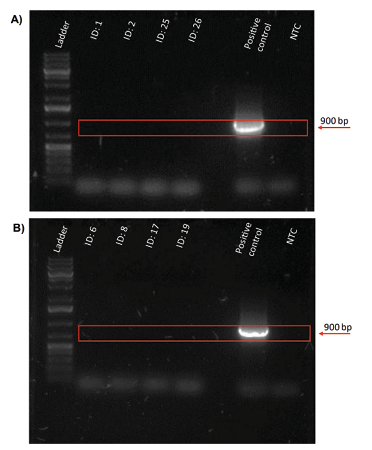
Figure 3. ITS1-F and NL 3 amplicons. Electrophoresis separation was performed on 1% agarose gel, stained with SYBR safe. A) Lane 1: Ladder (20 kb), Lane 2: PRG-WC/100 Slurry/No inorganic [ID: 1], Lane 3: MS/100 Slurry/No inorganic [ID: 2], Lane 4: PRG-WC/100 Slurry/No inorganic [ID: 25], Lane 5: MS/100 Slurry/No inorganic [ID: 26], Lane 6: Positive control (Yeast DNA) and Lane 7: No template control (NTC). B) Lane 1: Ladder (20 kb), Lane 2: MS/100 Slurry/100 inorganic [ID: 6], Lane 3: MS/No slurry/No inorganic [ID: 8], Lane 4: PRG-WC/100 Slurry/100 inorganic [ID: 17], Lane 5: PRG-WC/No Slurry/No inorganic [ID: 19], Lane 6: Positive control (Yeast DNA) and Lane 7: No template control (NTC).
4. Conclusions
Multispecies (MS) and perennial ryegrass – white clover (PRG-WC) silage following treatment with slurry and/or inorganic fertiliser have shown to be a potential source for animal feed in Ireland. The lack or presence of yeast was carried out by DNA extraction using a published protocol by [14], which was adapted by reducing the incubation period with proteinase K and 20% SDS from 16 h to 1 h for a higher yield of DNA and by adding a second 70% ethanol wash to improve the purity of the samples. When quantifying purity and concentration of DNA using Nanodrop spectrophotometry, the grass type had a positive influence on the DNA yield (ng/μL). MS samples showed a higher yield of DNA compared to PRG-WC, indicating the composition allowed more cells to be present and be lysed. The purity had no discrimination between MS and PRG-WC due to it remained below the recommended ratio for 260/280 and 260/230 nm absorbance. Caused by the remaining contaminants, grass type has an influence on DNA purity. Also, from all the treatments of fertilisers, slurry presence has a higher influence on MS samples yield, enhancing the amount of DNA. However, slurry treatments have no influence on DNA purity for MS nor PRG-WC. The DNA of the silage samples that presented heating were used to detect the presence of yeast by using yeast specific primers for PCR, being ITS1-F/NLB3 by [16] and [18] the most suitable pair due to the place it targets, which allowed to confirm there was no presence of yeast with the amplification of the positive control containing DNA of bread yeast. Conversely, the heating of the silage samples was not due to the presence of yeast, but of other factors like microbes, which represent an idea for further research on factors for aerobic spoilage where sequencing and targeting other microbes might help in solving the problem of aerobic deterioration by microorganisms.
References
- Environmental Protection Agency (EPA), “Chapter 13 - Environment and Agriculture. ,” Ireland’s Environment . https://www.epa.ie/publications/monitoring--assessment/assessment/state-ofthe-environment/EPA-Ireland%E2%80%99s-Environment-2020-Chapter13.pdf (accessed Aug. 22, 2023).
- E. Dillon et al., “Situation and Outlook for Irish Agriculture,” Teagasc, 2023.
- J. M. Wilkinson and D. R. Davies, “The aerobic stability of silage: key findings and recent developments,” Grass and Forage Science, vol. 68, no. 1, pp. 1–19, Jun. 2012, doi: https://doi.org/10.1111/j.1365-2494.2012.00891.x.
- T. Moloney, H. Sheridan, J. Grant, E. G. O’Riordan, and P. O’Kiely, “Conservation efficiency and nutritive value of silages made from grassred clover and multispecies swards compared with grass monocultures,” Irish Journal of Agricultural and Food Research, vol. 59, no. 1, pp. 150–166, 2020, doi: https://doi.org/10.2307/27041763.
- C. L. S. Ávila and B. F. Carvalho, “Silage fermentation—updates focusing on the performance of micro‐organisms,” Journal of Applied Microbiology, vol. 128, no. 4, pp. 966–984, Oct. 2019, doi: https://doi.org/10.1111/jam.14450.
- T. A. McAllister et al., “Silage review: Using molecular approaches to define the microbial ecology of silage,” Journal of Dairy Science, vol. 101, no. 5, pp. 4060–4074, May 2018, doi: https://doi.org/10.3168/jds.2017-13704.
- J. Silva and R. Uchida, “Inorganic Fertilizer Materials in Plant nutrient management in Hawaii’s soils: Approaches for tropical and subtropical agriculture” Honolulu, HI: College of Tropical Agriculture & Human Resources, University of Hawaii at Manoa, pp. 117–120, 2000, Accessed: Jan. 08, 2001. [Online]. Available: https://www.ctahr.hawaii.edu/oc/freepubs/pdf/pnm12.pdf
- T. Moloney, H. Sheridan, J. Grant, E. G. O’Riordan, and P. O’Kiely, “Herbage nutritive value of binaryand multispecies swards relative to singlespecies swards in intensive silage systems,” Irish Journal of Agricultural and Food Research, vol. 59, no. 1, pp. 167–184, 2020, doi: https://doi.org/10.2307/27041764.
- K. M. McCarthy et al., “Rumen fermentation and forage degradability in dairy cows offered perennial ryegrass, perennial ryegrass and white clover, or a multispecies forage,” Livestock Science, p. 105185, Feb. 2023, doi: https://doi.org/10.1016/j.livsci.2023.105185.
- Helvi Heinonen‐Tanski et al., “Aeration improves the hygiene of cattle slurry and the quality of grass forage and silage†,” Acta agriculturæ Scandinavica. Section B, Soil and plant science, vol. 48, no. 4, pp. 212–221, Dec. 1998, doi: https://doi.org/10.1080/09064719809362501.
- T. Moloney, H. Sheridan, J. Grant, E. G. O’Riordan, and P. O’Kiely, “Yield of binary- and multi-species swards relative to single-species swards in intensive silage systems,” Irish Journal of Agricultural and Food Research, vol. 59, no. 1, Mar. 2021, doi: https://doi.org/10.2478/ijafr-2020-0002.
- S. Baker et al., “Multispecies swards outperform perennial ryegrass under intensive beef grazing,” Agriculture, Ecosystems & Environment, vol. 345, no. 108335, p. 108335, Apr. 2023, doi: https://doi.org/10.1016/j.agee.2022.108335.
- L. Thanuja and S. R. Ambika, “Effect of Bacterization of Finger Millet Grains with the PGPRs Isolated from the Rhizoplane of Holostemma ada-kodien Schultes on its Germination and Initial Growth,” Journal of the Indian Society of Soil Science, Jan. 2010.
- J. P. Lynch, P. O’Kiely, S. M. Waters, and E. M. Doyle, “Conservation characteristics of corn ears and stover ensiled with the addition of Lactobacillus plantarum MTD-1, Lactobacillus plantarum 30114, or Lactobacillus buchneri 11A44,” Journal of Dairy Science, vol. 95, no. 4, pp. 2070–2080, Mar. 2012, doi: https://doi.org/10.3168/jds.2011-5013.
- M. Franco et al., “Fermentation Quality and Bacterial Ecology of Grass Silage Modulated by Additive Treatments, Extent of Compaction and Soil Contamination,” Fermentation, vol. 8, no. 4, pp. 156–156, Apr. 2022, doi: https://doi.org/10.3390/fermentation8040156.
- K. Martin and P. Rygiewicz, “Fungal-specific PCR primers developed for analysis of the ITS region of environmental DNA extracts,” BMC microbiology, vol. 5, no. 1, pp. 1–11, 2005.
- S. N. Leaw, H. C. Chang, H. F. Sun, R. Barton, J.-P. Bouchara, and T. C. Chang, “Identification of Medically Important Yeast Species by Sequence Analysis of the Internal Transcribed Spacer Regions,” Journal of Clinical Microbiology, vol. 44, no. 3, pp. 693–699, Mar. 2006, doi: https://doi.org/10.1128/jcm.44.3.693-699.2006.
- M. Gardes and T. D. Bruns, “ITS primers with enhanced specificity for basidiomycetes - application to the identification of mycorrhizae and rusts,” Molecular Ecology, vol. 2, no. 2, pp. 113–118, Apr. 1993, doi: https://doi.org/10.1111/j.1365-294x.1993.tb00005.x.
Autorización y Licencia CC
Los autores autorizan a APANAC XVIII a publicar el artículo en las actas de la conferencia en Acceso Abierto (Open Access) en diversos formatos digitales (PDF, HTML, EPUB) e integrarlos en diversas plataformas online como repositorios y bases de datos bajo la licencia CC:
Attribution-NonCommercial-ShareAlike 4.0 International (CC BY-NC-SA 4.0) https://creativecommons.org/licenses/by-nc-sa/4.0/.
Ni APANAC XVIII ni los editores son responsables ni del contenido ni de las implicaciones de lo expresado en el artículo.